
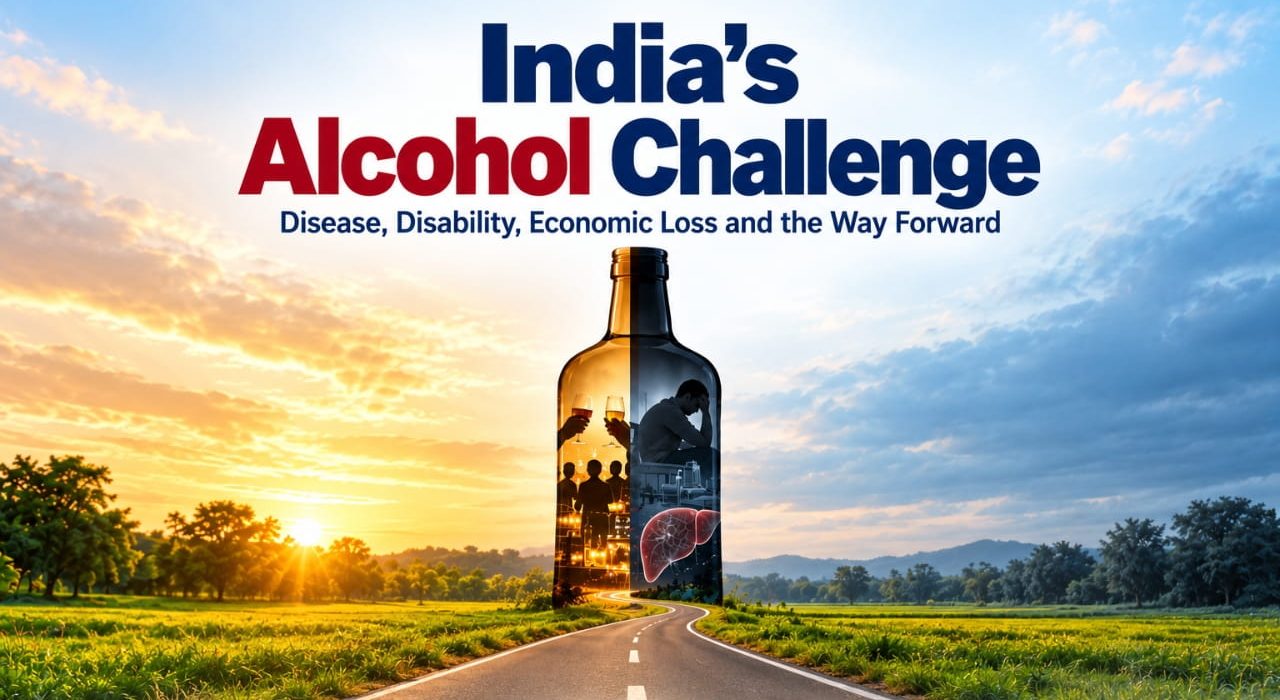
Alcohol occupies a paradoxical position in India—generating substantial revenue and accompanying socialization and celebration, while imposing a largely hidden burden of addiction, disease, injury, family disruption, lost productivity and premature death. Alcohol-related harm extends far beyond liver disease, making alcohol use disorder (AUD) a major health, social and economic challenge. Globally, alcohol was responsible for an estimated 2.6 million deaths in 2019, including substantial mortality from noncommunicable diseases and injuries. Its impact is particularly concerning among young adults, families and the productive workforce.
The Indian alcohol paradox
India differs from many Western countries. Although the proportion of the population that drinks is lower than in much of Europe, India’s population size means that even a modest prevalence translates into a very large number of people exposed to alcohol-related harm. The 2018 National Survey on Extent and Pattern of Substance Use, released in 2019, estimated that about 16 crore Indians consumed alcohol and more than 5.7 crore had harmful or dependent use requiring help. These figures remain an important national benchmark, but they should not be interpreted as current 2026 prevalence.
The burden is also highly heterogeneous. Alcohol use varies markedly by sex, state, culture, socioeconomic environment, beverage type, availability and state policy. India therefore does not have a single uniform alcohol problem; it has multiple alcohol epidemics requiring locally adapted responses within a coherent national health strategy.
Why alcohol harms India differently
One distinctive challenge is the alcohol-harm paradox: consumption and harm are not necessarily distributed in the same way. People with fewer socioeconomic resources may experience greater harm at comparable levels of alcohol exposure. Poor nutrition, smoking, hazardous occupations, delayed healthcare, limited ability to pay for treatment and household financial vulnerability can magnify the consequences.
India’s alcohol market includes beer, wine and regulated spirits alongside country liquor and unrecorded or informally produced alcohol. Ethanol remains the principal driver of chronic alcohol-related liver injury irrespective of beverage type, while informal alcohol can add risks from unpredictable strength and, occasionally, toxic adulteration. For vulnerable households, alcohol can create a double economic burden: expenditure on alcohol competes with food, education, housing and healthcare, while illness simultaneously reduces earning capacity.
The disease is much bigger than the liver
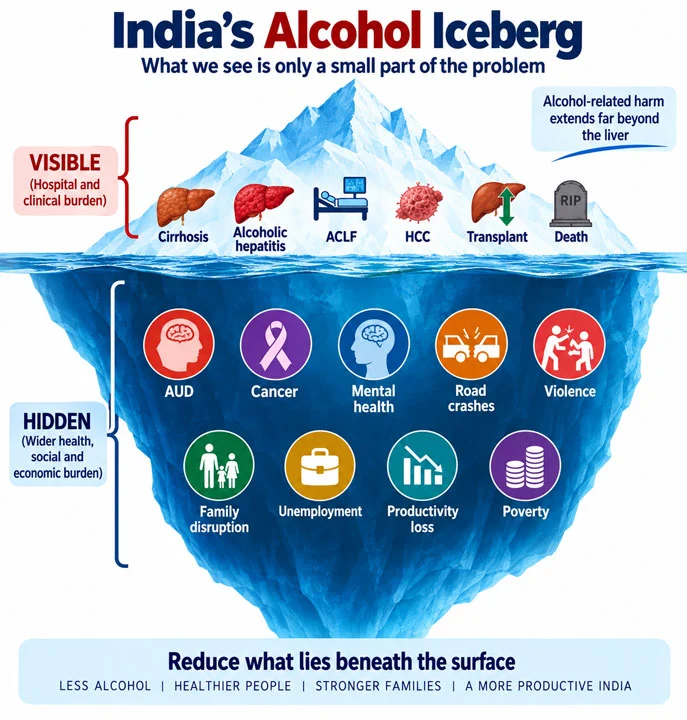
Hepatologists often encounter the visible end of the spectrum—alcohol-associated hepatitis, cirrhosis, acute-on-chronic liver failure, hepatocellular carcinoma and the need for transplantation. Yet alcohol-related harm extends much further. It contributes to cardiovascular disease, several cancers, mental and behavioural disorders, injuries and other health conditions. In 2019, about 401,000 cancer deaths worldwide were attributable to alcohol. Road crashes, falls, workplace injuries, violence and self-harm add another layer of preventable harm.
Alcohol also harms people who do not drink. Families can experience violence, financial insecurity and disruption; children may face psychological and social consequences; and communities bear the costs of road injuries, disability and lost productivity. The true burden is therefore better understood as a health–family–livelihood problem rather than simply a liver disease.
A new threat: alcohol meets India’s metabolic epidemic
India’s alcohol problem is entering a new phase. Abdominal obesity, diabetes, hypertension and metabolic dysfunction-associated steatotic liver disease (MASLD) are increasingly common, creating a population in which alcohol and metabolic risk frequently overlap. The emerging phenotype is MetALD—steatotic liver disease in which metabolic dysfunction and clinically relevant alcohol exposure coexist.
This overlap matters because alcohol-related risk is not determined by alcohol quantity alone. Age, sex, drinking pattern, obesity, diabetes, nutrition and genetic susceptibility modify vulnerability. Indian research has shown that metabolic and familial susceptibility may be associated with cirrhosis developing after a shorter duration and at lower alcohol exposure in some drinkers. The future burden may therefore increasingly reflect a metabolic–alcohol interaction rather than a purely alcohol-driven epidemic.
The public-health implication is important: alcohol reduction, weight control, diabetes management and cardiovascular-risk reduction should no longer be treated as separate agendas. For many patients, they are different components of the same disease pathway.
The cost India rarely counts
Perhaps the most compelling argument for action is economic. A modelling study examining alcohol-related liver disease, cancers and road traffic accidents in India over 2011–2050 estimated 258 million life-years lost and a healthcare-system burden of ₹3.127 trillion. When healthcare costs, out-of-pocket expenditure and productivity losses were combined, the projected societal burden reached ₹121.364 trillion. After accounting for alcohol-tax receipts, the model estimated a net economic loss of ₹97.895 trillion—averaging about 1.45% of GDP per year over the study horizon.
These are long-term modelled estimates, not India’s current annual alcohol bill. Nevertheless, they expose the limitation of viewing excise collections as the complete economic balance sheet. The more meaningful equation is: Alcohol revenue − Healthcare costs − Injuries − Disability − Productivity loss − Premature mortality − Household impoverishment
Alcohol can destroy livelihood before it destroys the liver
AUD frequently affects people during economically productive years. A harmful cycle may develop: drinking leads to absenteeism and impaired productivity; workplace conflict, injury or declining performance may lead to job loss; financial stress then increases vulnerability to further drinking and relapse. Harmful drinking → Absenteeism → Reduced productivity → Job loss → Financial stress → Deeper dependence
Treatment success therefore cannot be defined only as ‘not drinking’. Meaningful recovery includes abstinence or sustained reduction as clinically appropriate, improved physical and mental health, restored family relationships, return to work, economic independence and better quality of life.
Prevention must begin before the first hospital admission
The most effective strategy is to intervene early and at multiple levels simultaneously.
- Individual: Improve awareness, encourage early screening and ensure easy access to treatment. People who do not drink should not be encouraged to start for presumed health benefits.
- Family: Recognize harmful drinking early, support treatment and recovery, promote alcohol-free environments, and protect children in alcohol-affected families.
- Workplace: Provide confidential identification, treatment referral and structured return-to-work support to help interrupt the cycle of AUD → unemployment → poverty → relapse.
- Healthcare: Make validated screening and brief intervention routine in high-risk settings. Integrate addiction, mental-health and hepatology care, especially after alcohol-associated hepatitis or decompensated cirrhosis.
- Media & influencers: Reduce the association of alcohol with success, masculinity, glamour and celebration, with particular attention to digital and social-media marketing.
- Insurance: Support timely AUD treatment and rehabilitation before recurrent hospitalization and advanced disease generate greater long-term costs.
What government can do?
Individual responsibility matters, but alcohol-related behaviour is also shaped by price, availability, marketing, social norms, road-safety enforcement and access to treatment. WHO’s SAFER initiative provides a practical framework for reducing harmful alcohol use.
- Restrict availability: Use appropriate legal-age rules, licensing, outlet-density controls and hours-of-sale regulation.
- Prevent drink-driving: Strengthen detection, breath testing, enforcement and road-safety measures.
- Detect and treat early: Integrate screening, brief intervention and treatment into primary care, emergency services and hospitals.
- Restrict promotion: Address advertising, sponsorship, surrogate promotion and digital marketing, particularly exposure of young people.
- Use pricing wisely: Use evidence-based taxation and pricing approaches while monitoring illicit and unrecorded alcohol.
- Reinvest in prevention: Direct resources toward treatment, rehabilitation, road safety and public awareness.
- Think nationally, act locally: Set common health objectives while allowing state-specific implementation suited to India’s diversity.
The objective should shift from regulating alcohol sales alone to reducing disease, disability, premature mortality and economic loss.
India needs a fundamental shift
A successful alcohol strategy should be measured not only by consumption or attendance at de-addiction services, but by whether it prevents disease, saves lives, protects families, preserves employment, restores productivity and reduces economic harm.
| FROM | TO |
| From late disease | to early prevention |
| From detoxification | to continuing recovery |
| From stigma | to treatment |
| From individual blame | to shared responsibility |
| From fragmented specialties | to integrated care |
| From job loss | to occupational rehabilitation |
| From family suffering | to family participation |
| From inadequate financial protection | to appropriate health coverage |
| From alcohol revenue alone | to total societal-cost accounting |
| From abstinence as the only outcome | to survival, quality of life, productivity and livelihood |
Turning the cycle around
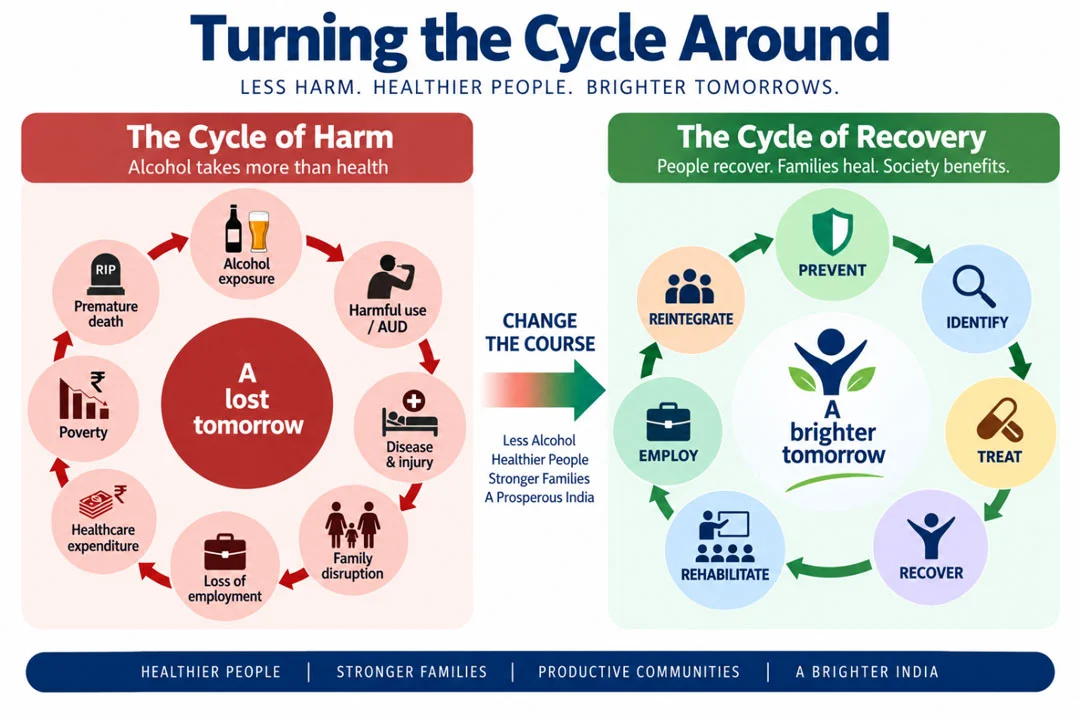
The wider pathway of harm is familiar: alcohol exposure can progress to harmful use or AUD, followed by disease, injury, family disruption, loss of employment, healthcare expenditure, poverty and premature mortality. The pathway India needs is the reverse:
PREVENT → IDENTIFY → TREAT → RECOVER → REHABILITATE → EMPLOY → REINTEGRATE
Conclusion
The ultimate measure of success should not simply be liters of alcohol consumed or numbers attending de-addiction centers. It should be fewer premature deaths, fewer families devastated by addiction, and fewer alcohol-related injuries, less advanced liver disease, preserved employment, lower catastrophic healthcare expenditure and better quality of life. Alcohol use disorder is treatable. Alcohol-related harm is partly preventable. The opportunity for India is to recognize that reducing this burden is not merely an addiction-control program—it is an investment in health, families, human capital, productivity and national development.
Key references
- World Health Organization. Global status report on alcohol and health and treatment of substance use disorders. Geneva: WHO; 2024.
- World Health Organization. Alcohol: Key facts. Updated 28 June 2024.
- Ministry of Social Justice and Empowerment, Government of India; AIIMS-NDDTC. Magnitude of Substance Use in India. National survey conducted 2018; report released 2019.
- World Health Organization. Implementing what works in alcohol policy: progress report on the SAFER initiative. Geneva: WHO; 2026.
- WHO SAFER Initiative. Five high-impact alcohol policy interventions: availability, drink-driving, screening/treatment, marketing restrictions, and pricing/taxation.
- Indian economic modelling literature on alcohol-attributable liver disease, cancers and road traffic injuries, 2011–2050, as summarized in the source draft.